Facial Hair Reduction

Category:
face
/
Skin
Permanent Smoothness: Precision Laser Solutions for Facial Refinement
Unwanted facial hair, often ranging from fine "peach fuzz" to coarse terminal hair on the chin and upper lip, is a significant concern for many Indian women. In our demographic, this is frequently driven by genetic predispositions or hormonal imbalances such as Polycystic Ovary Syndrome (PCOS). Unlike temporary methods like threading or waxing—which often lead to folliculitis, ingrown hairs, and Post-Inflammatory Hyperpigmentation (PIH) in the humid Indian climate—clinical hair reduction targets the follicle itself. At Clinic7, we utilize medical-grade technology to safely manage facial hair while preserving the integrity of your delicate facial skin.

Understanding the Root Cause;
The Hormonal-Melanin Axis
The growth of facial hair is governed by the sensitivity of hair follicles to Androgens (male hormones present in all women). When these levels fluctuate or when follicles are genetically hyper-sensitive, fine vellus hair converts into thick, dark terminal hair.
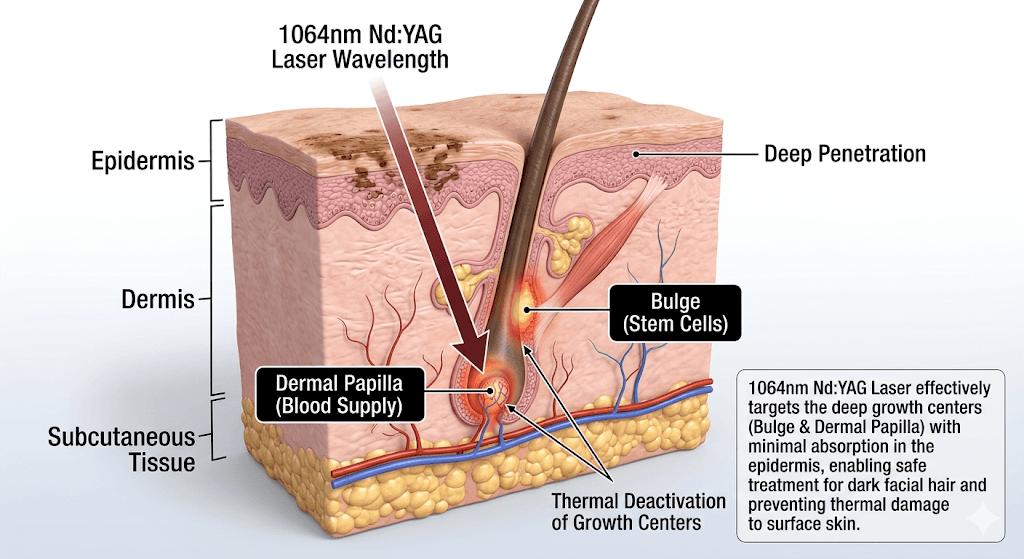
In the Indian context, the high concentration of melanin in both the hair and the skin creates a unique challenge. Standard lasers often struggle to distinguish between the pigment in the hair and the pigment in the skin. Furthermore, chronic friction from threading or "peel-off" masks triggers a defensive melanin response, leading to the dark "shadow" often seen around the mouth and jawline. Effective reduction requires a wavelength that can bypass the skin's surface melanin to reach the deep-seated follicular bulb.

Why Professional Intervention;
The Clinic 7 Clinical Advantage
Facial skin is thinner and more reactive than body skin. Generic "salon" lasers often lack the cooling power or wavelength specificity required for safe treatment on Indian complexions.
Dual-Wavelength Precision: We utilize both Gold-Standard Diode and Nd:YAG lasers. The Nd:YAG wavelength is "color-blind" to surface melanin, making it the safest option for darker Indian skin tones (Fitzpatrick IV-VI) to avoid burns or PIH.
Hormonal Integration: If hair growth is suspected to be hormonal, we don't just treat the surface. We provide a holistic diagnostic approach, coordinating with endocrinologists to manage the internal triggers for lasting results.
Dynamic Cooling Technology: Our systems feature integrated sapphire cooling tips that maintain the skin at a constant 4°C during the pulse, ensuring the procedure is virtually painless and the skin surface remains protected.
FAQs
Will the hair come back thicker if I start laser?
No. This is a common myth. Laser hair reduction actually thins the hair and slows the growth cycle. Unlike shaving, which blunts the hair tip, laser weakens the follicle itself.
Is it safe for PCOS patients?
Yes, it is the most recommended treatment for PCOS-related hair growth. While you may require more maintenance sessions due to ongoing hormonal stimulation, laser is the only way to significantly reduce the coarse hair and associated skin darkening.
Can I do this if I have active acne?
We generally recommend clearing active, inflamed acne before laser hair removal to avoid irritation. However, for non-inflammatory "clogged pores" caused by hair, laser can actually help clear the skin.
How many sessions are needed for the face?
Facial hair is hormonally driven and has a faster growth cycle. Most patients require 8 to 10 sessions, spaced 4 to 6 weeks apart, to achieve optimal, long-term clearance.
Will it remove grey or white hair?
No. Lasers target melanin (pigment). White, grey, or very light blonde hairs do not have enough pigment to absorb the laser energy. For these, we may recommend alternative grooming strategies.